
Uneven texture, dullness, dark spots, and visible fine lines are common reasons people reach for exfoliating treatments. Alpha hydroxy acids, including lactic acid, are popular because they can loosen dead surface cells and make skin look smoother and brighter.
Sunday Riley Good Genes All-In-One Lactic Acid Treatment is positioned as a multitasking leave-on treatment for exfoliation, radiance, discoloration, pores, and the appearance of wrinkles. Its formula combines lactic acid with licorice, prickly pear, moisturizing ingredients, and several botanical extracts.
That combination looks appealing at first glance, but an ingredient list needs closer examination. The amount of lactic acid is not disclosed, and that matters because an AHA’s effects depend partly on its concentration, pH, and overall formulation. The FDA’s AHA guidance explains this relationship clearly.
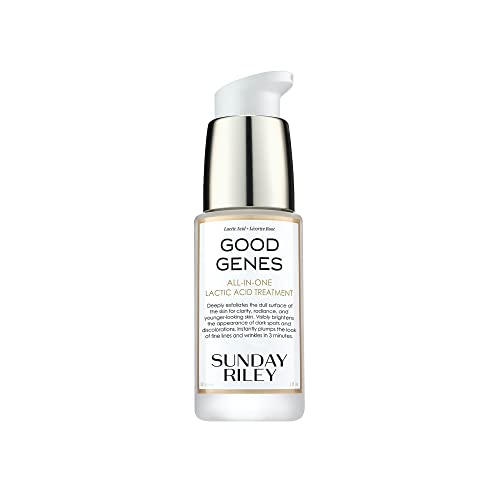
Sunday Riley Good Genes Ingredients at a Glance
The current ingredient list displayed by major U.S. retailers is below. Ingredient lists can change, so the packaging of the product you purchase should remain the final reference.
- Water (Aqua)
- Opuntia Tuna Fruit Extract
- Cypripedium Pubescens Extract
- Opuntia Vulgaris Leaf Extract
- Agave Tequilana Leaf Extract
- Arnica Montana Flower Extract
- Aloe Barbadensis Leaf Extract
- Saccharomyces Cerevisiae (Yeast) Extract
- Leuconostoc/Radish Root Ferment Filtrate
- Caprylic/Capric Triglyceride
- Squalane
- Lactic Acid
- PPG-12/SMDI Copolymer
- Propanediol
- Butylene Glycol
- Stearic Acid
- Dimethicone
- Cetearyl Alcohol
- Phenyl Trimethicone
- Disiloxane
- Ceteareth-20
- Glyceryl Stearate
- PEG-100 Stearate
- Stearyl Glycyrrhetinate
- Glycyrrhiza Glabra (Licorice) Root Extract
- Cymbopogon Schoenanthus (Lemongrass) Oil
- Potassium Hydroxide
- Phenoxyethanol
- Xanthan Gum
- Caprylyl Glycol
- Chlorphenesin
- Sodium Phytate
Sunday Riley Good Genes Ingredients: My Analysis
What stands out to me is that the formula is more than a simple acid serum. It combines an exfoliating active with emollients, silicones, humectants, and plant-derived ingredients, which can make the treatment feel more conditioned than a bare-bones acid formula.
Lactic Acid
Lactic acid is an alpha hydroxy acid produced commercially for cosmetic use and is closely related to the natural chemistry of skin. Its main cosmetic role here is exfoliation. AHAs help loosen connections between surface cells, encouraging the shedding of accumulated dead skin.
Human evidence supports topical AHAs for improving aspects of skin texture and appearance, although results depend heavily on the formulation. The FDA’s review of AHA safety evidence notes that concentration and formulation factors influence both exfoliation and sun sensitivity.
Good Genes does not disclose the exact percentage of lactic acid, so its concentration in this specific product cannot be determined from the current ingredient list. I would not use its position in the list to guess the amount or assume that it matches a concentration used in clinical research.
The ingredient therefore makes logical sense for the product’s exfoliating claims, but the finished-product evidence is more limited than the ingredient evidence. I find that distinction important: research supporting lactic acid generally does not automatically prove that this particular serum will produce the same degree of improvement.
Licorice Root Extract and Stearyl Glycyrrhetinate
Licorice is included for its potential skin-brightening and soothing properties. The formula also contains stearyl glycyrrhetinate, a licorice-derived ingredient. These choices make sense alongside lactic acid because discoloration is one of the product’s advertised concerns.
There is some human research behind topical licorice compounds for uneven pigmentation, but the evidence is considerably less established than the evidence for AHAs. Much of the research concerns particular licorice constituents or specialized formulations rather than Good Genes itself. I would therefore regard this as a supportive feature, not the formula’s primary reason to buy it.
The manufacturer doesn’t disclose the concentration of either licorice ingredient. That prevents a meaningful comparison with concentrations used in studies. The formula can reasonably be described as containing licorice-derived brightening ingredients, but it can’t be assumed that they are present at a clinically meaningful level.
Prickly Pear and Other Botanical Extracts
The botanical blend is a distinctive part of Good Genes. It includes prickly pear, orchid, blue agave, arnica, aloe, yeast extract, and radish-root ferment. Sunday Riley specifically positions several of these extracts as soothing or conditioning companions to lactic acid.
I can see the formulation logic here. A leave-on exfoliant can be uncomfortable for some people, so including moisturizing and skin-conditioning components may improve the overall sensory experience. However, botanical presence alone doesn’t establish a meaningful clinical benefit.
Prickly pear and aloe have plausible moisturizing or soothing roles, but the evidence for these particular extracts doesn’t carry the same weight as controlled clinical evidence for established exfoliating ingredients. Arnica is also worth treating cautiously because botanical extracts can cause sensitization in susceptible individuals.
Most importantly, the concentrations of these extracts aren’t disclosed. I wouldn’t interpret their prominent placement within the manufacturer’s botanical-blend declaration as proof that each is present at a high concentration. The available information simply doesn’t allow that conclusion.
Squalane
Squalane is an emollient that helps soften skin and reduce moisture loss. It is the hydrogenated, more stable form of squalene, a lipid naturally associated with human skin. In this formula, it helps give an exfoliating treatment a more conditioned feel.
That supporting role is useful because lactic acid can be drying or irritating for some users. Squalane doesn’t replace the exfoliating action of lactic acid, but it can contribute to the formula’s moisturizing character.
I consider squalane a sensible formulation choice here. Still, the product doesn’t disclose its percentage, so there’s no basis for claiming that Good Genes contains an especially high or therapeutically meaningful amount.
Other Ingredients
- Water (Aqua): Main solvent and vehicle for the formula.
- Caprylic/Capric Triglyceride: Emollient that helps soften skin and improve the product’s spread.
- PPG-12/SMDI Copolymer: Film-forming and texture-enhancing ingredient that contributes to product stability and feel.
- Propanediol: Humectant and solvent that can help attract water and dissolve other ingredients.
- Butylene Glycol: Humectant and solvent that supports hydration and product texture.
- Stearic Acid: Fatty-acid emollient and consistency agent used to structure the formula.
- Dimethicone: Silicone emollient that smooths skin and helps reduce moisture loss.
- Cetearyl Alcohol: Fatty alcohol used as an emollient and thickener; it isn’t the same as drying alcohol.
- Phenyl Trimethicone: Silicone that improves slip and leaves a smooth skin feel.
- Disiloxane: Lightweight silicone that improves spreadability and sensory feel.
- Ceteareth-20: Emulsifier that helps oil- and water-based ingredients remain blended.
- Glyceryl Stearate: Emollient and emulsifier that contributes to texture and formula stability.
- PEG-100 Stearate: Emulsifier that helps maintain a uniform cream-like formulation.
- Lemongrass Oil: Fragrant botanical oil. Fragrance components can cause irritation or sensitization in susceptible users.
- Potassium Hydroxide: pH adjuster used to control the acidity of the finished formula.
- Phenoxyethanol: Preservative used to help prevent microbial growth in cosmetics.
- Xanthan Gum: Thickener and stabilizer that improves the formula’s consistency.
- Caprylyl Glycol: Skin-conditioning ingredient that also supports the preservative system.
- Chlorphenesin: Preservative that helps protect the product from microbial contamination.
- Sodium Phytate: Chelating agent that helps stabilize the formula by binding trace metals.
- Citral: Fragrance component that can be relevant for people sensitive to fragrance allergens.
- Geraniol: Fragrance component with recognized sensitization potential for susceptible individuals.
- Limonene: Fragrance component that may oxidize and become more sensitizing over time.
Safety Concerns and Controversies
The clearest evidence-based precaution is sun sensitivity. Because Good Genes contains an AHA, the manufacturer advises sunscreen use and limiting sun exposure during use and afterward. This is consistent with the FDA’s discussion of AHA-related photosensitivity.
Some users may also experience stinging, dryness, redness, or irritation from an acidic leave-on treatment. Lemongrass oil and declared fragrance allergens add another consideration for fragrance-sensitive skin. I wouldn’t call these ingredients inherently unsafe, but sensitive users have a legitimate reason to be cautious.
One thing I wouldn’t do is treat every botanical extract or synthetic-sounding ingredient as a safety problem. The formula contains conventional preservatives, emulsifiers, silicones, and stabilizers that serve ordinary cosmetic functions. The bigger practical issue is individual tolerance to an exfoliating, fragranced leave-on product.
Sunday Riley Good Genes: My Verdict
Good Genes is a thoughtfully constructed exfoliating treatment, and its core concept makes sense. Lactic acid provides a scientifically credible exfoliating mechanism, while squalane, silicones, humectants, and botanical ingredients help create a more conditioning formula.
My main reservation is the missing concentration information. Because Sunday Riley doesn’t disclose the percentage of lactic acid, you can’t determine how closely this product matches concentrations studied for particular outcomes. The evidence supports the ingredient, but not every marketing claim made for this specific formula.
Overall, I’d put Good Genes in the “worth considering” category for someone seeking an AHA treatment and able to tolerate fragranced skincare. I wouldn’t buy it solely because of its long botanical list. The strongest reason to consider it is still the lactic acid-based exfoliating concept.
Disclaimer
This review is based mainly on ingredient analysis and available scientific research. Proven ingredients don’t guarantee the same results for every user. This article is educational and doesn’t replace personalized medical advice when professional guidance is appropriate.