
Fine lines, dullness, and dehydrated-looking skin can make a serum promising when it claims to plump, smooth, and support firmer-looking skin. The challenge is figuring out whether those promises are supported by the actual formula.
Biossance Squalane + Copper Peptide Rapid Plumping Serum combines humectants, squalane, copper peptides, ectoin, and several plant extracts. That gives it a thoughtful anti-aging and hydration-focused profile, at least on paper.
What interests me most is whether the evidence for these ingredients translates into this particular serum. The ingredient list reveals several useful components, but it also leaves some important questions unanswered, especially because concentrations aren’t disclosed.
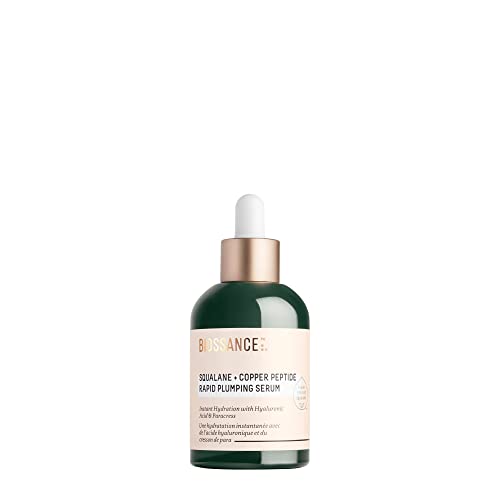
Biossance Squalane + Copper Peptide Serum Ingredients at a Glance
Biossance currently lists the following formula on its official product page. The brand also advises checking the packaging because formulas can change.
- Water/Aqua/Eau
- Glycerin
- Propanediol
- Squalane
- Sodium Hyaluronate
- Hydroxyethyl Acrylate/Sodium Acryloyldimethyl Taurate Copolymer
- Copper Tripeptide-1
- Acmella Oleracea Extract
- Ectoin
- Tetrapeptide-30
- Palmitoyl Hexapeptide-52
- Copper PCA
- Panthenol
- Sodium Polyglutamate
- Camellia Sinensis Leaf Extract
- Aloe Barbadensis Flower Extract
- Passiflora Incarnata Flower Extract
- Melia Azadirachta Leaf Extract
- Solanum Melongena (Eggplant) Fruit Extract
- Curcuma Longa (Turmeric) Root Extract
- Ocimum Basilicum (Basil) Flower/Leaf Extract
- Coccinia Indica Fruit Extract
- Melia Azadirachta Flower Extract
- Ocimum Sanctum Leaf Extract
- Corallina Officinalis Extract
- Polyacrylate Crosspolymer-6
- Acacia Senegal Gum
- Xanthan Gum
- Phenoxyethanol
- Ethylhexylglycerin
- Citric Acid
- Caprylyl Glycol
Biossance Squalane + Copper Peptide Serum Ingredients: My Analysis
This is a formula where the supporting ingredients actually make sense alongside the headline act. I’d focus most closely on squalane, copper tripeptide-1, ectoin, and the hydration system.
Squalane
Squalane is a stable, hydrogenated form of squalene, a lipid naturally found in human skin. In skincare, it primarily works as an emollient, helping soften the skin and reduce the feeling of dryness.
That makes its inclusion here logical. Biossance specifically describes squalane as supporting the moisture barrier, while the broader moisturizing literature supports the role of emollients and lipids in improving skin hydration.
There’s a useful distinction, though. Squalane itself isn’t a proven wrinkle treatment in the same sense as a prescription retinoid. Its contribution is more indirect: better moisturization can temporarily make fine lines look less noticeable and leave skin feeling smoother.
The manufacturer does not disclose the exact concentration of squalane, so its amount in this serum cannot be determined. I therefore wouldn’t infer its importance from ingredient order beyond recognizing that it’s a substantial component of the disclosed formula.
Copper Tripeptide-1
Copper tripeptide-1, commonly associated with GHK-Cu, is a copper-containing peptide investigated for effects involving skin repair and extracellular-matrix processes. That biological rationale explains why copper peptides have become popular in firming and anti-aging products.
Some research is encouraging, but the evidence deserves restraint. Laboratory and skin-penetration research shows that copper tripeptides can interact with skin tissue, while clinical evidence for visible rejuvenation is much more limited and doesn’t establish that every cosmetic copper-peptide serum will produce meaningful wrinkle reduction.
One clinical study of a copper tripeptide product after laser resurfacing found no significant objective improvement in wrinkles or overall skin quality compared with control treatment. That doesn’t disprove copper peptides, but it shows why ingredient-level enthusiasm shouldn’t automatically become a product-level promise.
Biossance does not disclose the concentration of Copper Tripeptide-1. Because the amount isn’t revealed, I can’t determine whether this serum contains a concentration comparable with any particular research preparation.
Ectoin
Ectoin is a naturally occurring osmolyte produced by microorganisms living in extreme environments. In topical skincare, it is valued for its water-binding and protective properties, making it an interesting supporting ingredient for a hydration-focused formula.
The evidence here is more practical than spectacular. A systematic review of topical ectoin found encouraging results for hydration and impaired skin-barrier conditions, although the reviewed products commonly contained 5.5% to 7% ectoin.
That matters for this serum because Biossance doesn’t disclose its ectoin concentration. The research therefore supports ectoin as an ingredient generally, but it doesn’t prove that this particular serum contains enough to reproduce those studied effects.
Panthenol and the Hydration System
Panthenol is provitamin B5 and a familiar moisturizing ingredient. It can help attract and retain water while supporting a softer skin feel, so I can see why it fits naturally into a serum designed around plumping and hydration.
Sodium hyaluronate, sodium polyglutamate, glycerin, and propanediol reinforce that approach. Humectants such as glycerin have substantial support for improving skin hydration, although the exact contribution of each ingredient depends on the finished formulation.
The manufacturer doesn’t disclose concentrations for these ingredients. That means I would view them as sensible moisturizing components rather than assume that any particular one is present at a clinically meaningful concentration.
Other Ingredients
- Water/Aqua/Eau: The primary solvent and base of the serum. It has no meaningful skincare benefit by itself.
- Glycerin: A humectant that helps attract water and improve skin hydration. Generally well tolerated in topical products.
- Propanediol: A solvent and humectant that also helps improve product texture. Usually considered low concern in cosmetic use.
- Sodium Hyaluronate: A form of hyaluronic acid that binds water. It supports surface hydration and a temporarily plumper appearance.
- Hydroxyethyl Acrylate/Sodium Acryloyldimethyl Taurate Copolymer: A thickener and stabilizer that helps create the serum’s texture.
- Acmella Oleracea Extract: A botanical extract used in skincare for smoothing and expression-line claims. Evidence for meaningful cosmetic effects remains limited.
- Tetrapeptide-30: A cosmetic peptide included for skin-conditioning purposes. Independent clinical evidence for this finished product is limited.
- Palmitoyl Hexapeptide-52: A synthetic peptide used for conditioning and anti-aging positioning. Product-specific clinical evidence is limited.
- Copper PCA: A copper-containing ingredient used for skin conditioning. Its presence adds to the formula’s copper-focused positioning.
- Camellia Sinensis Leaf Extract: Green-tea extract with antioxidant compounds. Topical evidence is promising, but results vary by formulation.
- Botanical Extracts: Aloe, passionflower, neem, eggplant, turmeric, basil, and related extracts mainly provide conditioning and antioxidant support. Their individual concentrations aren’t disclosed.
- Corallina Officinalis Extract: A red-algae extract used for conditioning. Evidence for major anti-aging effects in this serum is not established.
- Acacia Senegal Gum: A film-forming and texture-enhancing ingredient. It helps the formula feel smooth on application.
- Xanthan Gum: A thickener and stabilizer that helps keep the formula uniform.
- Polyacrylate Crosspolymer-6: A polymer used to control texture and viscosity. It is a formulation aid rather than a headline active.
- Phenoxyethanol: A widely used cosmetic preservative. Safety depends on exposure and concentration, with regulatory limits applying in some markets.
- Ethylhexylglycerin: A preservative booster and skin-conditioning ingredient. It is generally used at low concentrations.
- Citric Acid: Primarily used to adjust acidity. It can irritate very sensitive or damaged skin at sufficient exposure.
- Caprylyl Glycol: A humectant and preservative-support ingredient that also contributes to skin conditioning.
Safety Concerns and Controversies
Overall, I don’t see a major red flag in this ingredient list for normal cosmetic use. The more realistic concerns are irritation or sensitization, particularly for people with very reactive skin, rather than evidence that the formula is inherently dangerous.
The botanical-heavy portion also deserves perspective. “Natural” doesn’t automatically mean non-irritating, and plant extracts can contain compounds capable of causing sensitivity. Patch testing is sensible if your skin reacts easily, especially before applying a new serum broadly.
Biossance Squalane + Copper Peptide Serum: My Verdict
I find this formula promising, particularly as a hydrating and conditioning serum. Squalane, glycerin, humectants, panthenol, and peptides create a coherent formulation. The copper-peptide concept is scientifically interesting, but the clinical evidence is not strong enough to guarantee dramatic anti-aging results.
My biggest limitation is the undisclosed concentrations. Without them, I can’t judge whether the copper peptide, ectoin, or other highlighted ingredients match the amounts used in supportive research. I’d consider the serum reasonable for hydration and skin conditioning, but I wouldn’t buy it expecting a proven wrinkle treatment.
Disclaimer
This review is based mainly on ingredient analysis and available research. Proven ingredients don’t guarantee that every user will achieve the desired result. This article is educational and doesn’t replace personalized medical advice when appropriate.