
Dullness, uneven tone, visible dark spots, and early signs of skin aging are common reasons people reach for vitamin C serums. The challenge is that “vitamin C” describes a family of ingredients, and their research support can differ considerably.
Sunday Riley’s C.E.O. 15% Vitamin C Brightening Serum looks promising because it uses 15% tetrahexyldecyl ascorbate, an oil-soluble vitamin C derivative, alongside squalane, phytosterols, humectants, and glycolic acid. The brand positions it around brightness, firmness, antioxidant support, and discoloration.
That sounds impressive, but the ingredient list deserves a closer look. I want to separate what the formula can reasonably support from what comes mainly from marketing, especially because research on vitamin C derivatives is not as extensive as research on pure L-ascorbic acid.
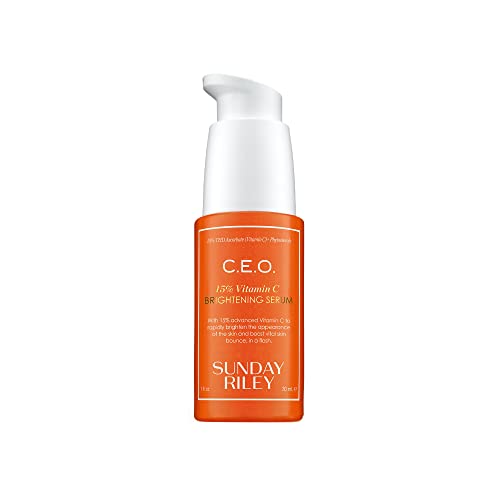
C.E.O. 15% Vitamin C Brightening Serum Ingredients at a Glance
The current UK formula provides the following ingredient list. Formulas can vary by market or change over time, so checking your package remains sensible.
- Water/Eau/Aqua
- Tetrahexyldecyl Ascorbate
- Squalane
- Polyglyceryl-6 Distearate
- PEG-8 Beeswax
- PPG-12/SMDI Copolymer
- Glycine Soja Sterols
- Sodium Phytate
- Tocopherol
- Acetamidoethoxyethanol
- Hydroxyethyl Acrylate/Sodium Acryloyldimethyl Taurate Copolymer
- Sodium Acrylate/Sodium Acryloyldimethyl Taurate Copolymer
- Jojoba Esters
- Glycolic Acid
- Caprylyl Glycol
- Cetyl Alcohol
- Polyglyceryl-3 Beeswax
- Chlorphenesin
- Glycerin
- Polysorbate 60
- Sorbitan Isostearate
- Saccharide Isomerate
- Citrus Aurantium Dulcis Peel Oil
- Citrus Tangerina Peel Oil
- Linalool
- Limonene
- Phenoxyethanol
C.E.O. 15% Vitamin C Serum Ingredients: My Analysis
The formula’s biggest selling point is clearly its vitamin C derivative. I also see meaningful support from the moisturizing and barrier-focused ingredients, while glycolic acid adds a secondary exfoliating angle.
Tetrahexyldecyl Ascorbate
Tetrahexyldecyl ascorbate, often shortened to THD ascorbate, is a fat-soluble derivative of vitamin C. Sunday Riley states that this is the serum’s 15% vitamin C ingredient and describes it as stable and oil-soluble. The official product information confirms the disclosed concentration.
Vitamin C has a reasonable scientific foundation for topical skincare. A 2023 systematic review of topical vitamin C found evidence of benefit for photoaging and pigmentation, although the authors also emphasized that the evidence base remains limited.
The important qualification is that this evidence does not automatically prove that THD ascorbate performs identically to pure L-ascorbic acid. A dedicated review of vitamin C derivatives notes that derivatives vary in stability, skin conversion, and clinical evidence. That makes the finished-product evidence especially relevant.
Sunday Riley reports a 30-person clinical study showing improvements in brightness and firmness after four weeks. Those results are useful as product-specific evidence, but the small sample and lack of detailed independent publication mean I would treat them as encouraging rather than definitive proof.
Squalane
Squalane is a skin-conditioning emollient that helps make a serum feel smoother and more comfortable. Here, it also makes practical formulation sense because THD ascorbate is oil-soluble, while squalane contributes a soft, moisturizing base.
I like seeing squalane alongside a potentially active vitamin C ingredient because it can improve the formula’s cosmetic elegance without relying on fragrance for a pleasant sensory experience. The Cosmetic Ingredient Review safety assessment concluded that squalane and squalene are safe in cosmetic use under the conditions evaluated.
Glycine Soja Sterols
Glycine Soja Sterols are soybean-derived phytosterols. Sunday Riley includes them as part of its barrier-supporting strategy and says the complex contains at least 40% beta-sitosterol. The brand specifically links the ingredient to reducing the appearance of redness from sensitivity.
There is some human evidence behind the general idea. A study of topical soybean phytosterols found improved recovery of the skin barrier after controlled disruption. That human study is encouraging, although it does not establish that this serum will produce the same result.
Glycolic Acid
Glycolic acid is an alpha-hydroxy acid that can loosen bonds between surface skin cells, helping improve rough texture and visible dullness. Sunday Riley also says it helps keep the formula’s pH in the appropriate range.
I would not treat the glycolic acid here as the star of the formula. Its exact concentration is not disclosed, so its strength cannot be determined from the ingredient list. Research on glycolic acid includes higher-concentration professional treatments, which cannot simply be compared with this serum.
Other Ingredients
- Polyglyceryl-6 Distearate: An emulsifier that helps oil and water-based ingredients stay blended. It is primarily a formulation-support ingredient rather than an active treatment.
- PEG-8 Beeswax: Helps thicken and stabilize the serum while contributing texture. Its presence doesn’t indicate a particular skincare benefit.
- PPG-12/SMDI Copolymer: A synthetic conditioning and film-forming ingredient that helps control texture and support the formula’s feel on skin.
- Sodium Phytate: A chelating agent that binds trace metals and helps protect formula stability. It isn’t included as a primary brightening treatment.
- Tocopherol: Vitamin E, an antioxidant and skin-conditioning ingredient. Topical vitamin E is generally well tolerated, although sensitivity is possible in susceptible individuals.
- Acetamidoethoxyethanol: A humectant and skin-conditioning ingredient intended to help maintain hydration. The manufacturer identifies it as part of the formula’s moisturizing system.
- Hydroxyethyl Acrylate/Sodium Acryloyldimethyl Taurate Copolymer: A texture and stabilization ingredient that helps create the desired serum consistency.
- Sodium Acrylate/Sodium Acryloyldimethyl Taurate Copolymer: A polymer used for viscosity control and stabilization. It doesn’t function as a principal active ingredient.
- Jojoba Esters: Emollient ingredients that help soften skin and improve the serum’s sensory feel. They mainly support moisturization rather than directly treating pigmentation.
- Caprylyl Glycol: A multifunctional ingredient used for skin conditioning and preservation support. It is generally considered well tolerated at cosmetic-use levels.
- Cetyl Alcohol: A fatty alcohol that thickens and stabilizes formulations while providing emollient properties. It isn’t the same as drying ethanol.
- Polyglyceryl-3 Beeswax: A beeswax-derived emulsifying and consistency-supporting ingredient that helps give the serum its structure.
- Chlorphenesin: A cosmetic preservative that helps prevent microbial growth. Preservation is important in water-containing products, although sensitive users can occasionally react.
- Glycerin: A well-established humectant that attracts water to the outer skin layers. It supports hydration and can improve the feel of a treatment formula.
- Polysorbate 60: An emulsifier and solubilizing ingredient that helps different components remain evenly distributed throughout the serum.
- Sorbitan Isostearate: An emulsifier that helps maintain a stable mixture of ingredients. It is primarily functional rather than an advertised treatment active.
- Saccharide Isomerate: A carbohydrate-derived humectant used to support hydration and the skin barrier. The manufacturer highlights it as part of the serum’s moisturizing system.
- Citrus Aurantium Dulcis Peel Oil: Sweet orange peel oil provides a botanical component and scent. Citrus oils can be problematic for people with fragrance sensitivity, despite the product’s fragrance-free marketing.
- Citrus Tangerina Peel Oil: Tangerine peel oil functions mainly as a botanical and aromatic ingredient. People sensitive to fragranced skincare may prefer to avoid it.
- Linalool: A naturally occurring fragrance component associated with citrus and other essential oils. Oxidized linalool can cause allergic contact reactions in susceptible people.
- Limonene: A citrus-associated fragrance component. Research shows that its oxidation products can trigger allergic contact dermatitis in some sensitized individuals.
- Phenoxyethanol: A widely used cosmetic preservative that protects water-containing formulas from microbial contamination. It is generally considered safe at permitted cosmetic concentrations.
Safety Concerns and Controversies
My main safety concern isn’t the vitamin C itself. THD ascorbate is a non-acidic derivative, so it may be more comfortable than acidic vitamin C formulas for some users. Still, “gentle” isn’t a guarantee that every skin type will tolerate it.
The more notable issue is the presence of orange and tangerine peel oils plus linalool and limonene. Oxidized forms of limonene and linalool are recognized contact allergens. This doesn’t mean the serum is unsafe for everyone, but fragrance-sensitive users should be more cautious.
There’s also a terminology wrinkle worth mentioning. Sunday Riley describes the serum as fragrance-free, yet the ingredient list contains citrus peel oils and fragrance allergens. That may reflect the company’s definition of added fragrance, but the practical point for sensitive skin is that aromatic ingredients are still present.
C.E.O. 15% Vitamin C Brightening Serum: My Verdict
Overall, I think this is a well-constructed vitamin C serum with a sensible combination of antioxidant, moisturizing, and barrier-supporting ingredients. The strongest point is the disclosed 15% THD ascorbate, while the supporting ingredients should make the formula more cosmetically comfortable.
The evidence for topical vitamin C is encouraging. A systematic review of clinical studies found improvements in pigmentation and photoaging, although it also concluded that more research is needed to establish ideal concentrations. Research specifically involving THD ascorbate exists, but remains much smaller than the broader vitamin C literature.
I am therefore comfortable calling C.E.O. promising, rather than proven. The formula makes scientific sense, but the manufacturer does not disclose the concentration of most supporting ingredients, and its own 30-person clinical study is not equivalent to a large independent randomized trial.
For someone seeking a vitamin C serum and comfortable with citrus-derived aromatic ingredients, I think this formula is worth considering. For someone prone to fragrance-related reactions, I would choose a genuinely fragrance-free alternative instead. The ingredient list is its biggest qualification, not a hidden safety disaster.
Disclaimer
This review is based mainly on ingredient analysis and available scientific research. Proven ingredients don’t guarantee identical results for every user. This article is educational and doesn’t replace personalized medical advice when professional guidance is appropriate.